
How to Search Delta County Traffic Records
Delta County does not run its own traffic case-search website. There is no county-branded portal that lists tickets, hearing dates, or dispositions. Instead, traffic infractions filed with the district court appear in the statewide MiCOURT case search, where records may be viewed by name or by citation number. What you see depends on how the court publishes each case, so some details may be limited.
Gather a few things before you start. The citation number, the driver name exactly as printed, the date of birth, and the offense date all help narrow a search. A driver license number is useful when a common name returns many matches.
- Open the MiCOURT case search and select the trial court option.
- Enter the citation number, or type the driver last name and first name.
- Add the date of birth or offense date to narrow the results.
- Review the case details, the charge, and the disposition.
- Move to payment, a plea, or a certified copy request from the court.
When the case does not appear online, contact the court directly for a status update or a copy of the file.
Which Court Handles Delta County Traffic Cases
Michigan splits its trial work among circuit, district, and probate courts. There is no justice court, municipal court, or magistrate court for traffic in Delta County. The 94th District Court handles traffic, civil infractions, and non-traffic infractions for the county, along with misdemeanors and small civil matters. A driver who wants to appeal a district court decision takes that appeal to the 47th Circuit Court.
The district court, the circuit court, and the clerk all share the downtown Escanaba courthouse. That keeps most traffic questions at one address.
You can review the court's jurisdiction on the 94th District Court page, which confirms that traffic and infraction cases fall under this court.
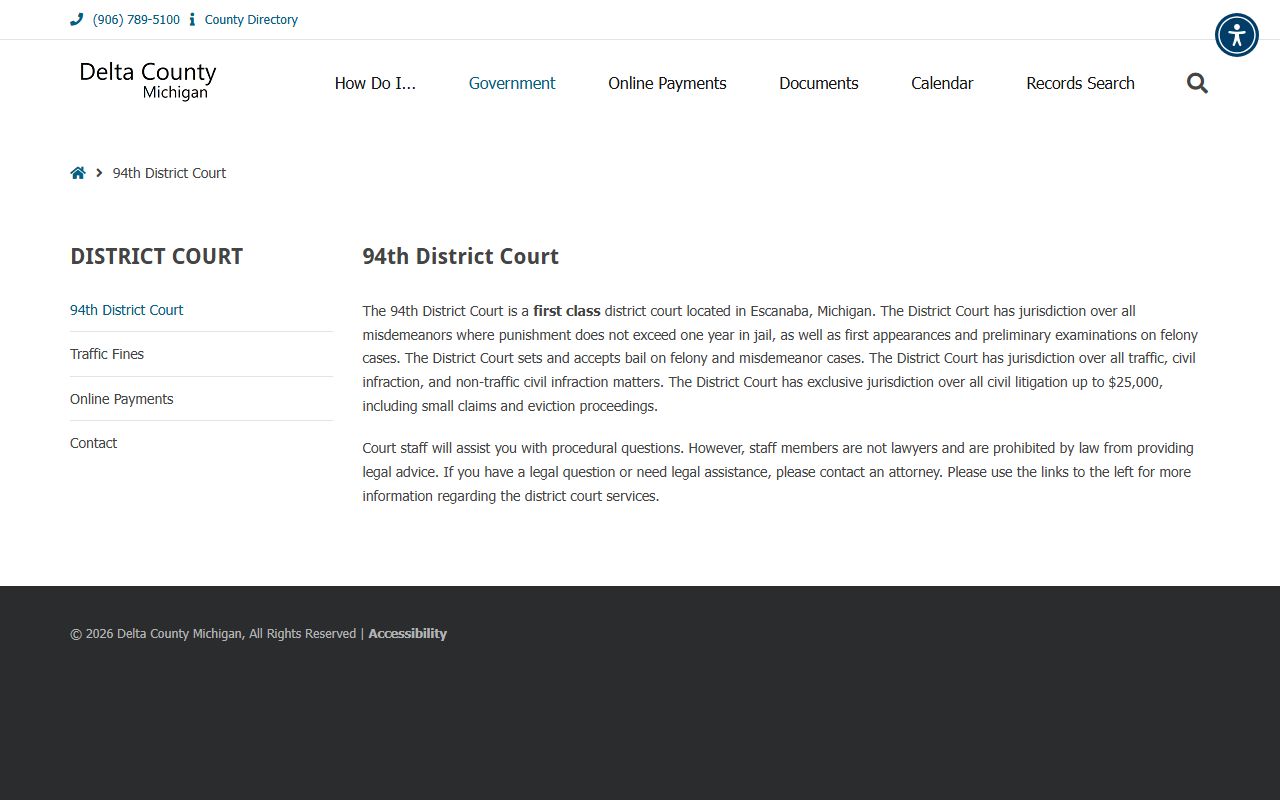
The page above is the starting point for anyone tracing where a Delta County traffic case is heard.
| Court | Traffic Cases Handled | Address |
|---|---|---|
| 94th District Court | Traffic and non-traffic civil infractions, misdemeanors | 310 Ludington Street, Escanaba, MI 49829 |
| 47th Circuit Court | Appeals from district court traffic decisions | 310 Ludington Street, Escanaba, MI 49829 |
How to Read a Delta County Traffic Citation
The back of a Michigan citation gives you three ways to respond. You can admit responsibility, admit responsibility with an explanation, or deny responsibility. Admitting means you accept the ticket and pay. Admitting with an explanation lets you ask the court to consider your side before it sets the fine or points. Denying means you want a hearing to contest the charge.
Sign and date the back of the citation for the option you choose. The court must receive the signed citation within 10 days. Miss that window and the court can enter a default against you.
Deadline warning. Return the signed citation within 10 days of the ticket. A default judgment can add costs and put your driving privileges at risk.
Questions about a specific ticket can go through the district court contact page.
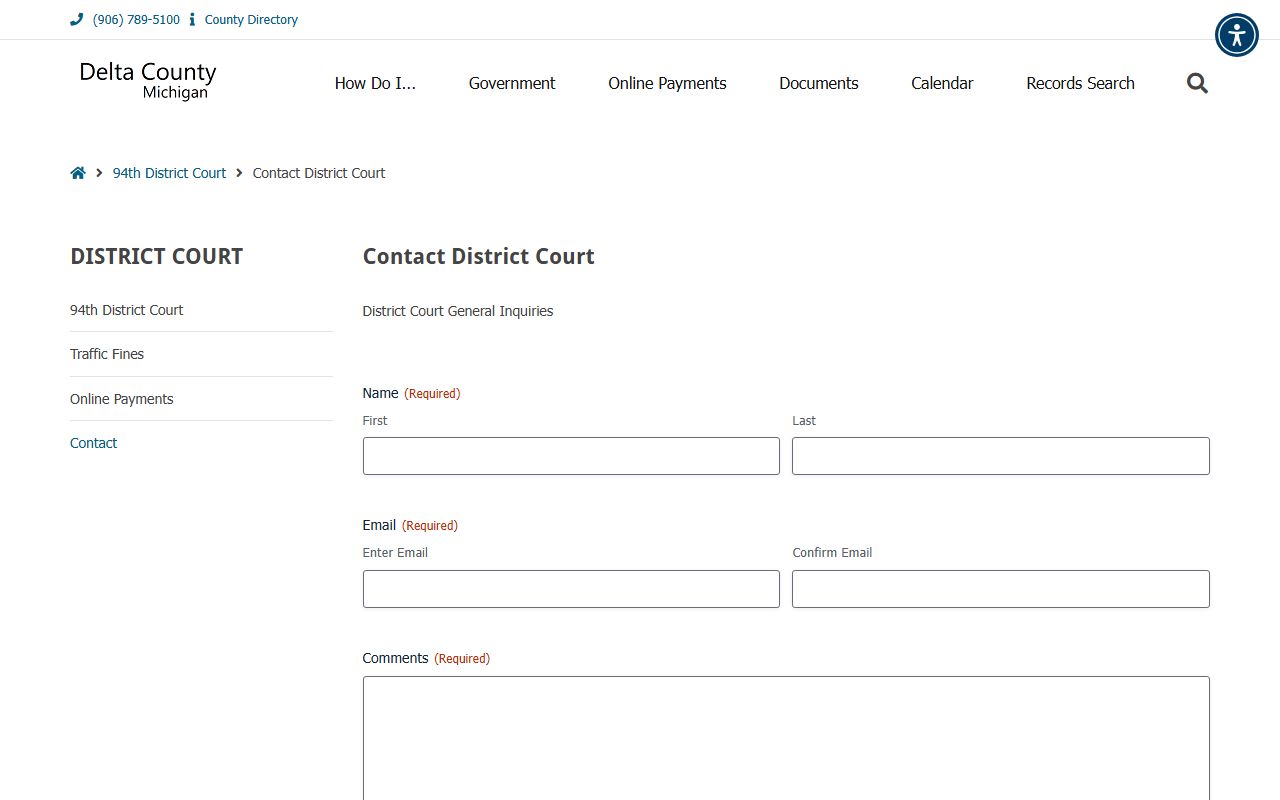
That contact page routes citation questions to the court staff who process traffic responses.
What Delta County Traffic Records Show
A traffic case file is a running summary of the ticket and its outcome. It names the charge, the statute cited, and the court that heard it. It also records the plea option the driver chose, the fine and costs, and any points assigned. The sample inventory below lists the fields you are most likely to see in a Delta County traffic court record.
| Field | What It Shows |
|---|---|
| Citation Number | The unique number printed on the ticket by the issuing officer. |
| Charge / Statute | The named violation and the Michigan law it falls under. |
| Court Date | The scheduled hearing or appearance date, if one is set. |
| Plea Option | Admit, admit with explanation, or deny responsibility. |
| Disposition | The final outcome, such as responsible, dismissed, or reduced. |
| Fine and Costs | The dollar amount owed to the court. |
| Points Assessed | The points added to the driver record on a responsible finding. |
Protected personal details, such as a full date of birth or a license number, are handled under Michigan court rules and may be limited in public copies.
Searching by Citation Number or Name
A citation number is the fastest way to pull one case. It points straight to a single ticket with no guesswork. A name search casts a wider net and works when the ticket is lost, but a common name can return several people. Adding a date of birth or an offense date trims those matches. The table lists the search fields the statewide system supports.
| Search Field | Type | Required | Notes / Format |
|---|---|---|---|
| Case / Citation Number | Text | No | Best single-case match; enter exactly as printed. |
| Last Name and First Name | Text | No | Use with a date to narrow common names. |
| Date of Birth | Date | No | Separates people who share a name. |
| Driver License Number | Text | No | Pair with the license state field. |
| Case Status | Text | No | Filter open, closed, or paid cases. |
| Offense Date Range | Date | No | Limits results to a time window. |
Note: name spellings and nicknames can differ from the license, so try a few variations before deciding a record does not exist.
Delta County Traffic Fines and Points
The district court publishes a fine schedule so drivers can see the cost of common violations before they respond. Amounts cover the fine and court costs, and points apply only when the driver is found responsible. Points attach to the state driving record, not to the court file. The schedule below shows sample rates for frequent tickets.
The full schedule and the current payment instructions appear on the traffic fines page.
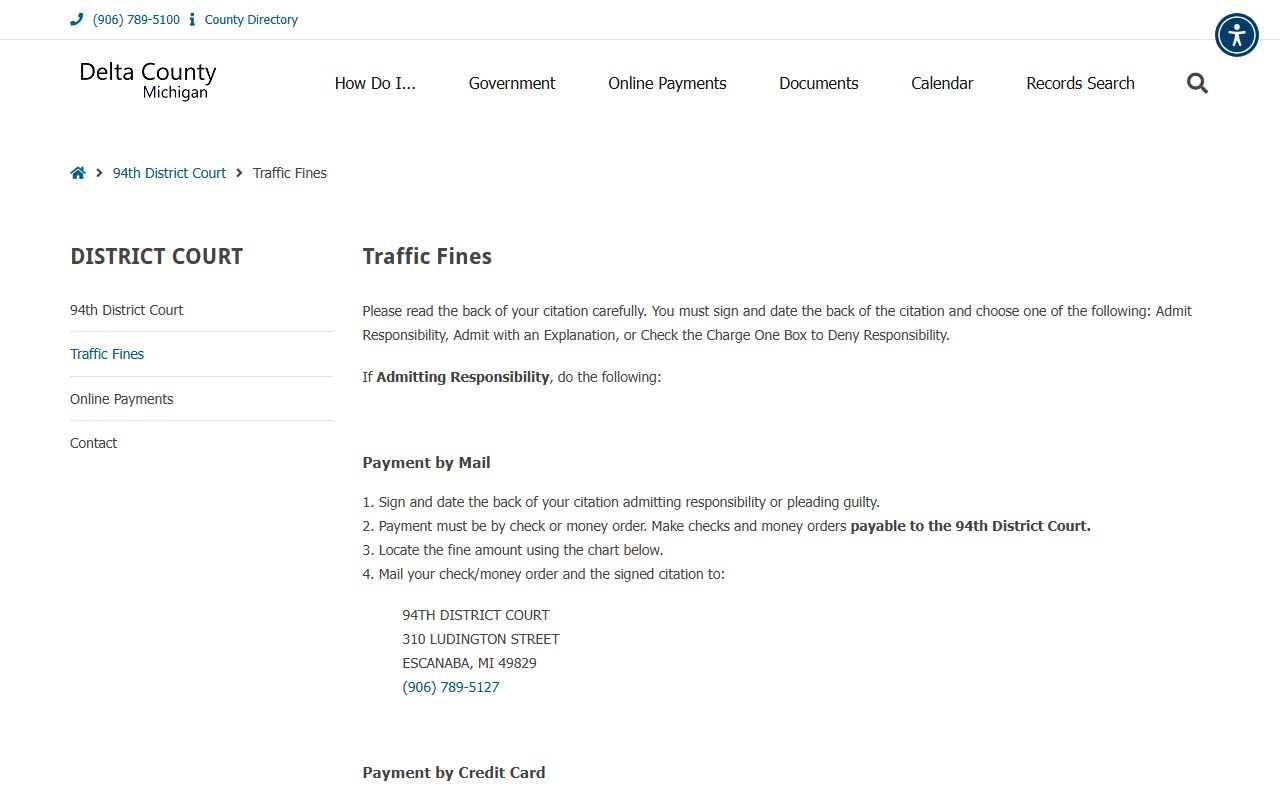
That page lists the ticket amounts the county uses, mirrored in the sample below.
| Violation | Fine and Costs | Points |
|---|---|---|
| Speeding 1 to 5 mph over | $125 | 1 |
| Speeding 6 to 10 mph over | $125 | 2 |
| Speeding 11 to 15 mph over | $135 | 3 |
| Fail to signal a turn | $125 | 2 |
| Fail to yield | $125 | 2 |
| Improper parking | $75 | 0 |
| No proof of valid insurance | $150 | 0 |
| Park in a handicapped zone | $200 | 0 |
| Pass a stopped school bus | $200 to $275 | 3 |
| Seatbelt violation | $65 | 0 |
Paying or Contesting a Delta County Traffic Ticket
The court accepts payment three ways. You can mail a check or money order made out to the 94th District Court. You can call the pay-by-phone card line at 1-888-604-7888 and give pay location code 1163. You can also pay online through the GovPayNet service on the county's district court bill page. To contest instead, deny responsibility on the citation and wait for the court to set a hearing.
Deadlines matter. You generally have six weeks to pay in full. After 30 days, the court sends a 14-day notice, and unpaid obligations can lead to a driver license suspension.
Start an online payment on the district court bills page.
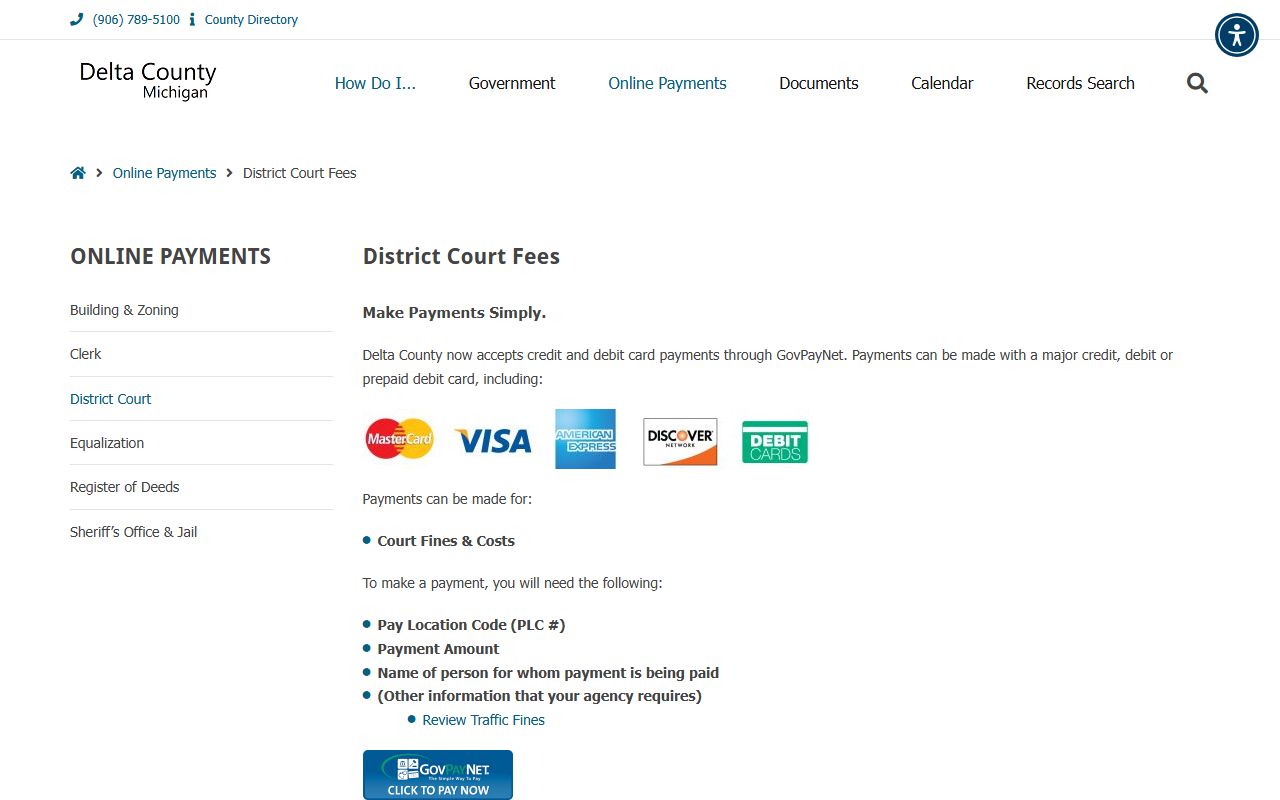
That page runs card payments through GovPayNet for district court traffic fines.
- Decide whether to admit, admit with an explanation, or deny the ticket.
- Sign and date the citation, then return it within 10 days.
- To pay, mail a check, call 1-888-604-7888 with code 1163, or pay online.
- To contest, deny responsibility and wait for the hearing notice.
- Keep your receipt or confirmation for your records.
Court Traffic Records vs State Driver Records
Two separate files follow a traffic ticket. The court traffic record is the case file kept by the district court. The state driver record is a history kept by the Michigan Secretary of State. A citation disposition can affect both, but they are maintained apart, updated by different offices, and requested in different ways. The comparison below shows how they differ.
The Secretary of State record-sales resources explain how the state side works for the public and for businesses. See the SOS record-sales page for those methods.
That resource covers the state driver record, the counterpart to the county traffic case file.
| Question | Court Traffic Record | State Driver Record |
|---|---|---|
| Record Source | 94th District Court | Michigan Secretary of State |
| What Is in It | Citation, charge, plea, disposition, fine, costs | License status, points, suspensions, conviction history |
| Where to Access | MiCOURT search or the district court | Michigan.gov SOS driving-record service |
| How to Correct | Ask the district court that entered the case | Contact the Secretary of State about the driver file |
State Driver Records From Michigan SOS
The Secretary of State sells the official driving record. Online records cost $15, and a certified record costs $16. An electronic driving-record link stays active for only seven days, so download or print it quickly. Records ordered in person at an office come certified.
Two mail forms handle written requests. Form BDVR-154 is the non-account request, and form BDVR-153 is the account-holder request. Both ask for requestor details, the record type, payment, and a mailing address.
Order a record from the Michigan driving-record page.
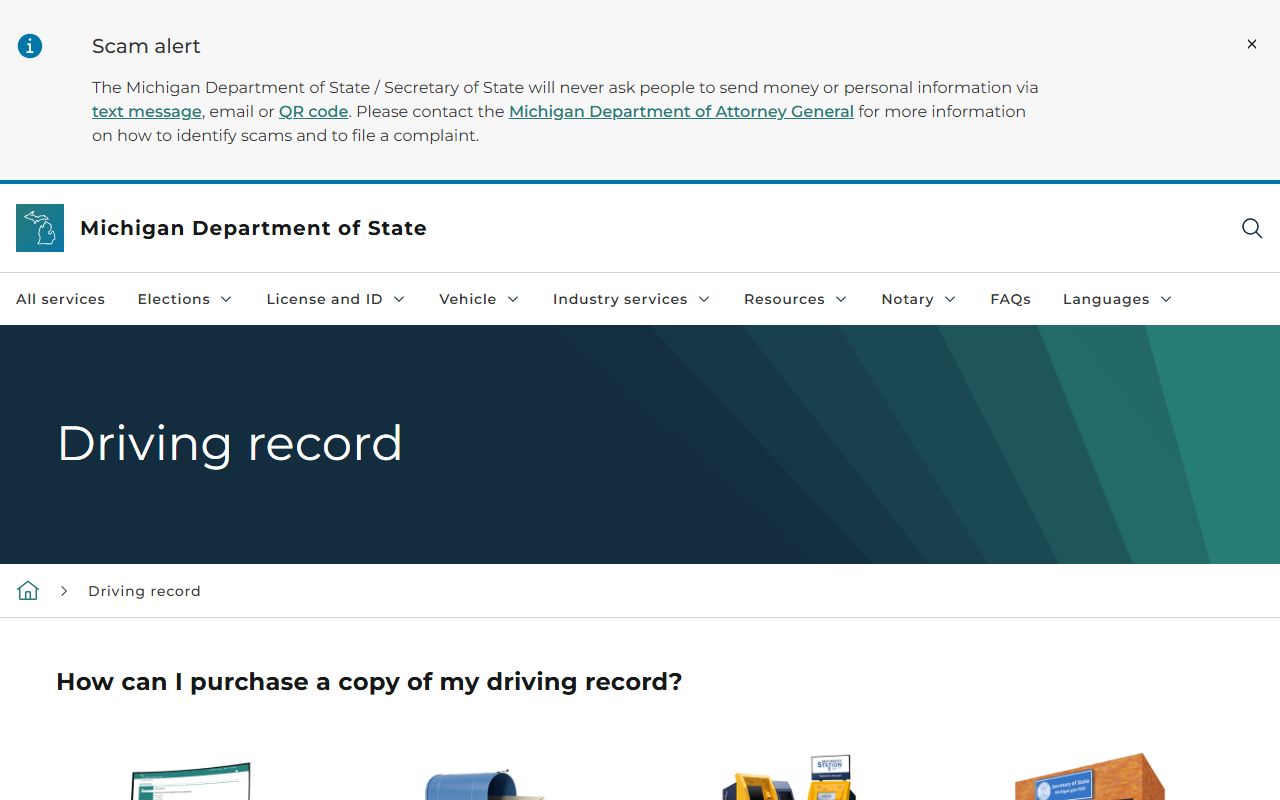
That page confirms the price, the seven-day link limit, and the request options for a state driver record.
CDL and Commercial Driver Records
Commercial drivers face stricter rules. A commercial driver license, or CDL, carries federal reporting duties, so convictions flow to the driver record even for a ticket received in a personal vehicle. Many violations cannot be masked or set aside the way they might be for a standard license. A CDL holder who receives a citation should read the plea options carefully and consider legal advice before responding, since a single serious offense can trigger a disqualification.
Note: the district court handles the citation, but the effect on a commercial license is decided by state and federal driver-record rules.
DUI and DWI Cases in Delta County
Drunk-driving charges are not ordinary traffic infractions. Operating while intoxicated is a criminal offense that starts in the district court and, for felony levels, moves to the circuit court. These cases carry arraignments, possible jail, and a separate criminal file rather than a simple fine.
For full Delta County DUI and DWI case information, see Delta County criminal court records.
Deferred Adjudication and Defensive Driving
Michigan does not offer a broad defensive-driving course that erases a civil infraction the way some states do. The practical path to relief is the admit-with-explanation option printed on the citation. That option lets a driver ask the court to lower the fine or reduce the points before a final decision.
Any reduction rests with the court. A first-time driver with a clean history has the best chance, but the judge or magistrate weighs each request on its own facts.
Sealing or Expunging Traffic Records
Most traffic tickets are civil infractions, not crimes, so they usually fall outside Michigan's expungement statute. Points on the driving record are not erased on request; they age off over time under state rules. Convictions that rise to a criminal level, such as some repeat or serious driving offenses, may qualify for a set-aside, though certain driving-related categories are excluded by law.
An applicant who believes a criminal traffic conviction may qualify should review the Michigan set-aside statute and the court forms before filing.
Public Access and Traffic Record Fees
Michigan court records are public unless a statute, rule, or order restricts them. When a traffic case is not posted online, the fallback is a request to the district court counter or a Michigan FOIA request to the county. The county clerk supplies certified copies for a set fee, and the state sells the separate driving record. The table lists common copy costs.
Key Statutes:
Michigan Court Rule 8.119 - court records are open to the public unless restricted by law or order.
Michigan Compiled Laws Section 15.231 - the Freedom of Information Act favors full access to public records.
| Item | Amount |
|---|---|
| Certified copy, first page | $10 |
| Certified copy, each additional page | $1 |
| State driving record (online) | $15 |
| State driving record (certified) | $16 |