
How to Search Delta County Court Records
Delta County does not run one combined case-search website. The county's public records are split across several official venues, and the right starting point depends on the record you want. County clerk pages hold the birth, death, and marriage indexes. The statewide MiCOURT case search covers civil, traffic, criminal, domestic, and probate cases by court. OTIS tracks people supervised by the Michigan Department of Corrections. The Secretary of State sells driver records. When a file is not online, a Freedom of Information Act request to the county is the fallback.
Gather a few details before you start. A full name, a birth year, or a case number will narrow almost any search.
- Pick the county index or state system that matches the record type.
- For court cases, open MiCOURT and search by name, case number, or filing date where available.
- For vital records, use the county birth, death, or marriage index and search by last name.
- Add a birth year, book and page, or parent names to trim large result sets.
- For a Corrections offender, use OTIS with a last name or offender number.
- If the file is old, sealed, or missing online, file a county FOIA request or visit the clerk's counter.
The Delta County Judicial System
Michigan runs a three-tier court system, and Delta County fits it directly. At the top sit the Michigan Supreme Court and the Michigan Court of Appeals, the state's intermediate appellate court. Below them are three trial courts. The 47th Circuit Court is the county's main trial court. It handles felony cases, civil disputes above the district limit, family matters, and appeals from the district court. The 94th District Court takes misdemeanors, traffic, civil infractions, and smaller civil claims. The Delta County Probate Court handles estates, wills, guardianship, and conservatorship.
Each bench has one presiding judge. Judge John Economopoulos leads the 47th Circuit Court. Judge Steven C. Parks presides over the 94th District Court. Judge Perry Lund runs the Delta County Probate Court. The circuit court's family division works with the Friend of the Court on custody, parenting time, and support. Appeals do not stop at a county appellate division. They move up to the Michigan Court of Appeals, and then, by leave, to the Michigan Supreme Court.
Case flow: 94th District Court › 47th Circuit Court › Michigan Court of Appeals › Michigan Supreme Court
| Court | Jurisdiction | Case Types |
|---|---|---|
| 94th District Court | Misdemeanors and civil up to $25,000 | Traffic, civil infractions, small claims, evictions, misdemeanors |
| 47th Circuit Court | Felonies and higher civil | Felony trials, family division, civil above $25,000, district appeals |
| Delta County Probate Court | Estates and protective matters | Wills, estates, guardianship, conservatorship, trusts |
The Michigan Supreme Court explains how the state's trial courts connect on its main courts overview page.
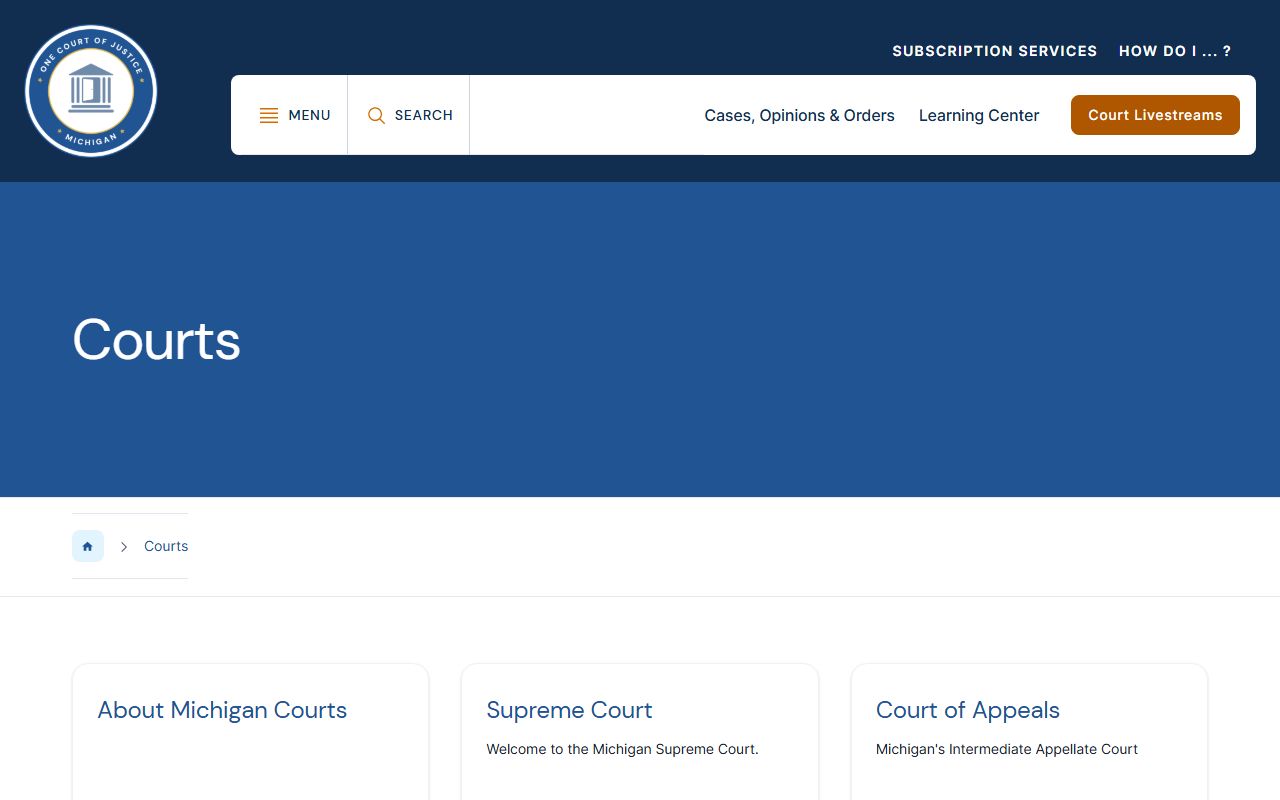
That statewide structure is what places the 47th Circuit and 94th District courts inside a single, shared framework.
Search Delta County Records Online
MiCOURT is the closest thing to a statewide case search. It may show civil, traffic, criminal, domestic, and probate cases, depending on the court. The system searches by name, case number, judge, and several date ranges. Results are paginated, and only some case details can be expanded, so a search returns a summary rather than the full paper file. For births, deaths, and marriages, the Delta County clerk publishes separate online indexes that need no login.
| Field Label | Type | Required | Notes |
|---|---|---|---|
| Last Name | text | one of name or case number | core search field |
| First Name | text | no | narrows results for common names |
| Case Number | text | one of name or case number | points to a single case |
| Date of Birth | date | no | helps match a specific person |
| Case Type Category | dropdown | no | civil, criminal, traffic, domestic, probate |
| Case Status | dropdown | no | open or closed |
| File Date From / To | date | no | limits results by filing window |
Michigan's trial courts directory lists every circuit, district, and probate court that feeds records into the statewide system.
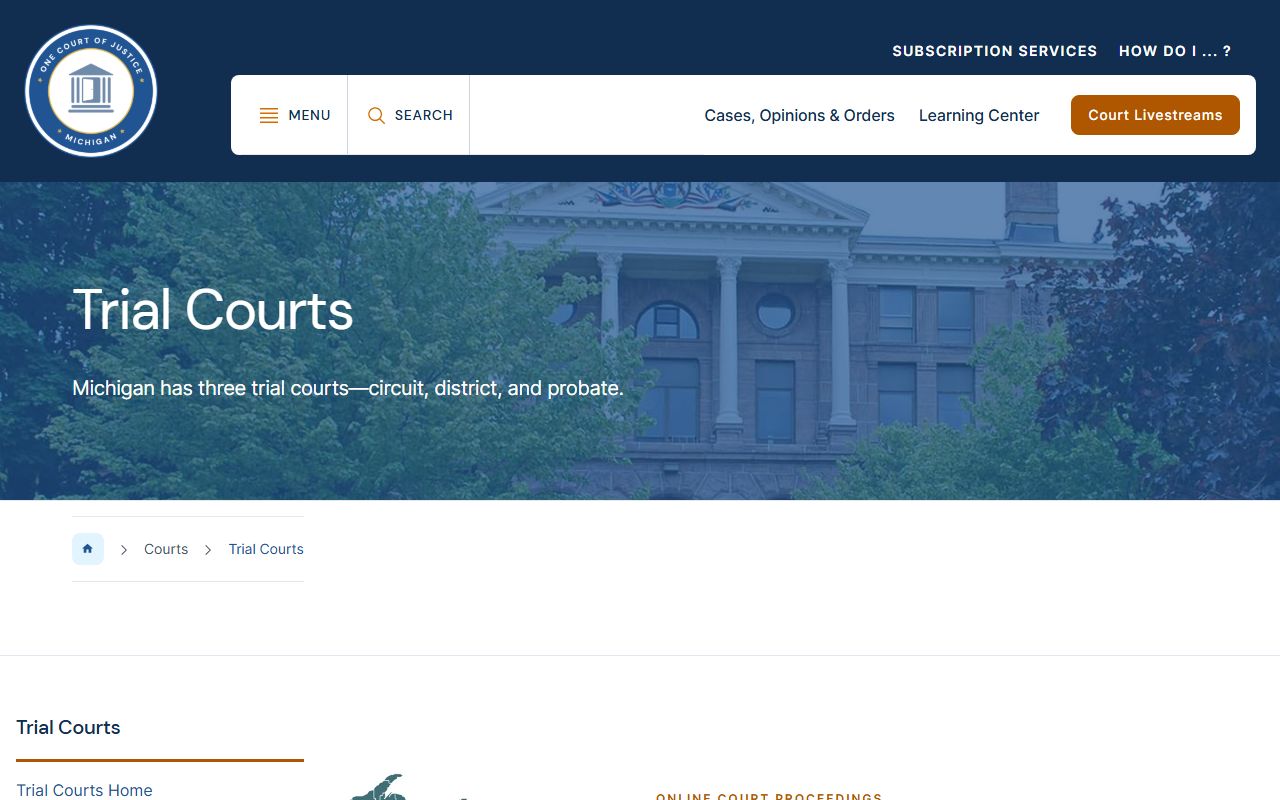
Because the courts share one platform, a Delta County case can turn up in the same search as any other Michigan county.
Note: a case can appear in one system and not another, so a blank MiCOURT result does not always mean no record exists in Delta County.
Delta County Courthouse and Office Hub
Most of Delta County's court business runs out of one downtown building. The Delta County Courthouse stands at 310 Ludington Street in Escanaba. The county clerk, circuit court, district court, probate court, Friend of the Court, and prosecutor all share that address. Regular public hours are 8:00 a.m. to 4:00 p.m. A single switchboard, (906) 789-5100, routes most calls. Court hours and general courthouse hours are not always identical, since remote public access appears only when the building is closed.
One address does not mean one office. The clerk, each court, and the prosecutor own different parts of the record.
Delta County Prosecuting Attorney
310 Ludington Street
Escanaba, MI 49829
(906) 789-5100
The county's official directory keeps the current list of judges, the clerk, the sheriff, and the prosecutor.
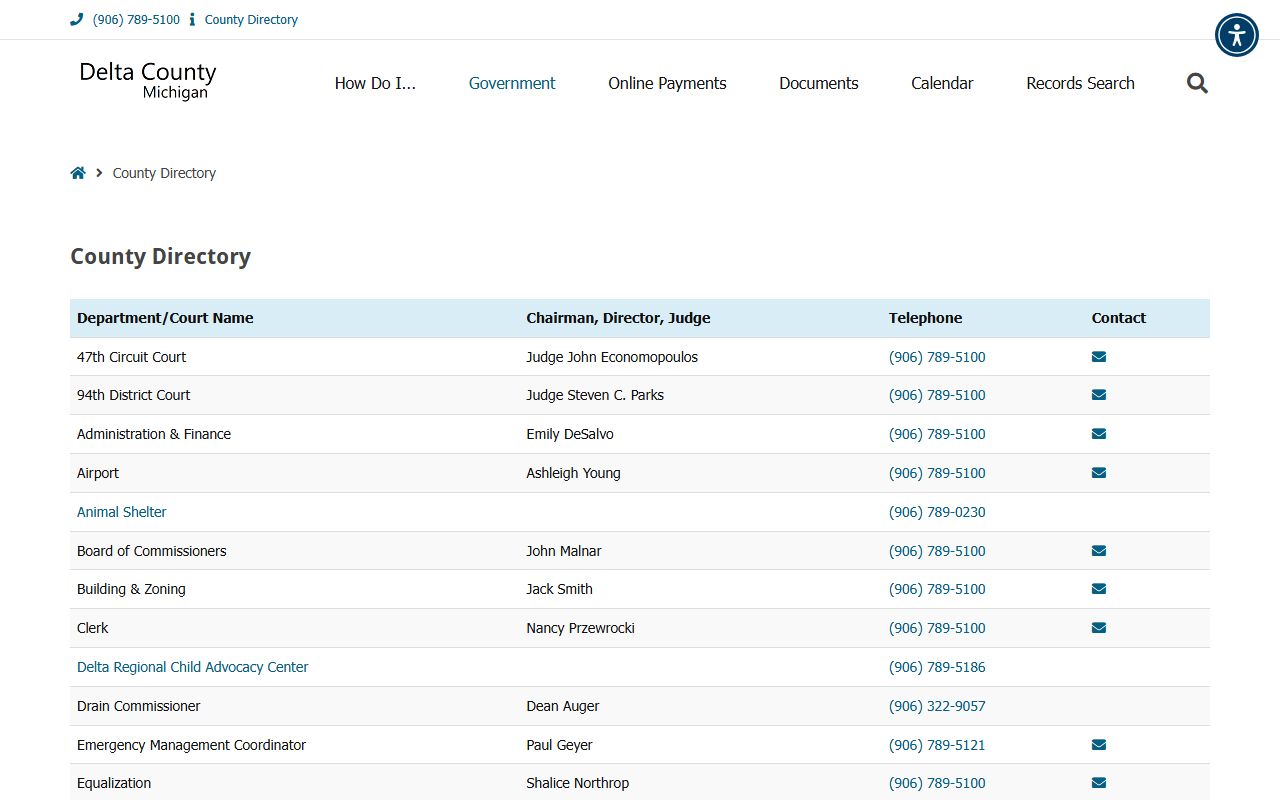
Checking that directory first tells you which office actually owns the record before you make a call.
Types of Court Records in Delta County
Delta County's courts generate the full range of case records. Criminal files run from misdemeanors in the district court to felony trials in the circuit court. Civil cases split by dollar amount. The district court hears claims up to $25,000, including small claims and evictions, while larger suits go to the circuit court. Family cases, divorce, custody, paternity, and support, sit in the circuit court's family division. Probate covers wills, estates, and guardianship. Traffic tickets and civil infractions land in the district court.
Juvenile matters are handled separately and are closed to the public under state law.
- Criminal records - misdemeanor and felony cases, from first appearance through sentencing.
- Civil records - money disputes, small claims, and landlord-tenant evictions.
- Family and divorce records - divorce, custody, and support matters in the circuit court.
- Probate records - wills, estates, guardianship, and conservatorship.
- Traffic records - citations and civil infractions in the district court.
What Delta County Court Records Show
A court record is more than a name and a charge. Each file carries a set of standard fields that tell the story of the case. The case number identifies the file. The filing date marks when the case opened. Party and attorney names show who is involved. The docket lists every motion, order, and hearing. The disposition records the outcome, and any sentence or judgment follows. Michigan protects certain personal details, so dates of birth, Social Security numbers, and account numbers are redacted from public copies.
| Field | What It Shows |
|---|---|
| Case Number | Unique ID for the file, often coded by case type. |
| Filing Date | When the case was opened with the court. |
| Parties | Plaintiff and defendant, or petitioner and respondent. |
| Charges / Cause | The criminal counts or the civil claim. |
| Disposition | The final outcome of the case. |
| Sentence / Judgment | The penalty imposed or the money award. |
The state's court records management office sets the rules for what stays public and what gets sealed.
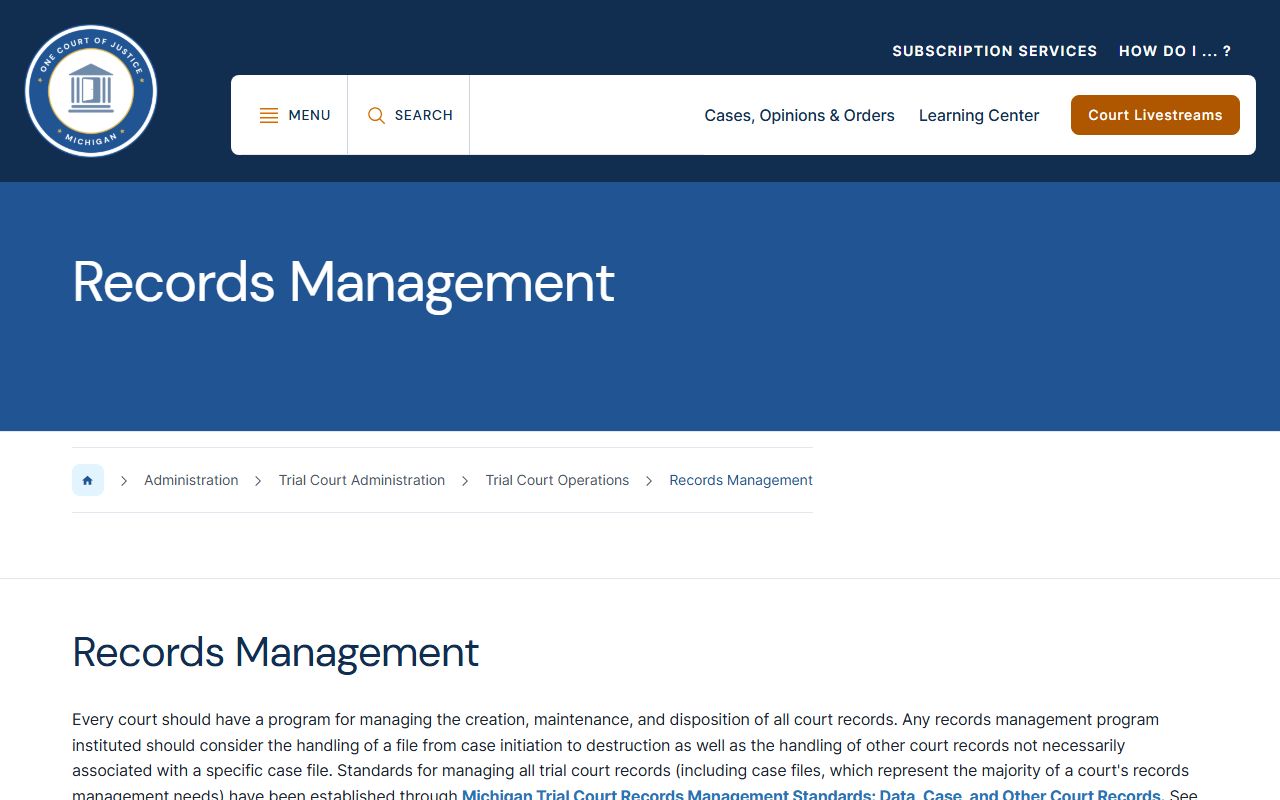
Those statewide standards decide which fields in a Delta County file a member of the public can view.
Note: protected personal details filed on or after April 1, 2022 must be kept out of public documents unless a court rule allows otherwise.
Public Access Laws for Delta County Records
Court records in Delta County are public by default. Michigan's Freedom of Information Act favors open access to government information, and the Michigan Court Rules treat case files as public unless a statute, rule, or sealing order says otherwise. Access still has limits. Personal identifying information is redacted, juvenile files are closed, and set-aside convictions drop out of public view. For records the county has not put online, a written FOIA request to the county is the standard route.
Key Statutes:
MCL 15.231 - Michigan's FOIA sets a public policy favoring full access to government records.
MCL 15.243 - lists the exemptions that let an office withhold certain records.
MCR 8.119(H) - makes court records public unless restricted by statute, rule, or order.
MCL 780.621 - controls who may petition to set aside, or expunge, a conviction.
MCL 712A.28 - keeps juvenile records closed except by court order.
Restricted and Confidential Delta County Records
Not every court file is open. Juvenile records are sealed by state law and open only by court order. Adoption and many mental-health files stay closed as well. When a conviction is set aside under Michigan's expungement statute, it is removed from public databases, though fines and costs already paid are not refunded. Personal data like birth dates and account numbers is redacted from the public version of otherwise open files.
Setting aside a conviction follows a set path.
- Confirm the offense qualifies under Michigan's set-aside statute.
- Complete the SCAO application form MC 227.
- Pay the $50 application fee.
- Send a copy to the Michigan State Police Criminal Justice Information Center.
- Serve the prosecutor and file with the convicting court.
Delta County Sheriff and Jail
The Delta County Sheriff's Office runs county law enforcement and the local jail. Sheriff Todd Tardiff leads the office at 2800 College Avenue in Escanaba. The Delta County Correctional Facility shares that address and holds up to 156 beds. The sheriff's pages explain visitation, bond, and property rules, but they do not publish a searchable inmate roster. No public warrant list appears on the county site either. For a person in state prison or on parole, OTIS is the correct tool, though it excludes county-jail inmates.
That gap shapes how to check custody here. Booking questions go to the jail by phone. A warrant question routes to the sheriff, the district court, or a FOIA request, since no online warrant index exists. Full booking detail and any statewide data live on the Delta County inmate records page, and active-warrant channels are covered under warrant records. Bond can be posted at the lobby kiosk, which runs around the clock.
Marriage, Divorce, and Probate Records
The county clerk issues marriage licenses and keeps the vital indexes. A Michigan resident applies in the county of residence, and a non-resident applies in the county where the wedding happens. There is a three-day waiting period, and the license stays valid for 30 days. Divorce is a circuit court family matter, with the Friend of the Court handling custody and support. Probate runs on MiFILE, the state e-filing system, where attorneys must e-file and self-represented filers may choose to. Copies of marriage and divorce records come from the clerk and the circuit court.
- Testator
- A person who makes a will.
- Executor
- The person named to carry out a will.
- Conservator
- Someone appointed to manage another person's finances.
- Intestate
- Dying without a valid will.
Delta County Court Records Fees
The county clerk sets the fees for filings and copies. Payments to the clerk go by check or money order made out to the Delta County Clerk's Office. A certified copy costs more than a plain one because it carries the clerk's seal for legal use. Divorce filing fees change based on whether minor children are involved. The core amounts appear below.
| Item | Amount |
|---|---|
| Filing fee | $175.00 |
| Motion fee | $20.00 |
| Certified copy, first page | $10.00 |
| Certified copy, each additional page | $1.00 |
| Divorce without minor children | $175.00 |
| Divorce with minor children | $255.00 |
How to Read Delta County Court Records
Court files use shorthand that can confuse first-time readers. Case-number prefixes flag the type of case. CV marks civil, CR criminal, FM family, PR probate, and JV juvenile. Traffic and infraction files often carry TC or TR. A charge is only an accusation. A conviction is a finding of guilt, and a disposition is the final outcome, which may be a dismissal, a plea, or a verdict. Reading these terms correctly keeps a pending charge from being mistaken for a settled result.
History of Delta County Courts
Delta County was organized in 1861, and its name comes from the delta the Escanaba River forms as it reaches Little Bay de Noc. Escanaba was incorporated in 1866 and became the county seat. Lumber, mining, and commercial fishing built the early economy. The court system has modernized in recent years. In 2024, the Delta County Circuit Court moved onto Michigan's statewide case management system, and the probate court adopted MiFILE for electronic filing. Those changes bring local records closer to the state's shared platforms.
Frequently Asked Questions
Is there one website for all Delta County court records?
No. Delta County does not run a single combined case portal. Vital records sit in the county clerk's birth, death, and marriage indexes. Court cases are searched through the statewide MiCOURT system. State prison and parole data lives in OTIS, and driver records come from the Secretary of State. When a record is not online, a county FOIA request fills the gap.
How do I look up a Delta County court case?
Start with MiCOURT case search. Enter a last name or a case number, then narrow by case type or filing date if the list is long. Civil, traffic, criminal, domestic, and probate cases may appear depending on the court. For older or paper-only files, contact the circuit or district court counter directly.
Are Delta County court records public?
Most are. Michigan's Freedom of Information Act and the Michigan Court Rules make case files public unless a statute, rule, or sealing order restricts them. Personal identifying information is redacted. Juvenile files and set-aside convictions are closed to the general public.
Does Delta County post a jail roster or warrant list online?
No public inmate roster or warrant list was found on the county or sheriff pages. For booking questions, call the jail at (906) 786-3633. For a possible warrant, contact the sheriff, the 94th District Court, or file a FOIA request. OTIS covers state offenders only, not county-jail inmates.
How much is a certified copy from the clerk?
A certified copy costs $10 for the first page and $1 for each additional page. The certified copy carries the clerk's seal, which is required for legal proceedings. Payments to the clerk are made by check or money order to the Delta County Clerk's Office.
Where is the Delta County Courthouse?
The courthouse is at 310 Ludington Street in downtown Escanaba, MI 49829. Public hours run 8:00 a.m. to 4:00 p.m. The clerk, circuit court, district court, probate court, and prosecutor all share that address, and the main switchboard is (906) 789-5100.
What if a record is not available online?
File a Freedom of Information Act request with the county, or visit the clerk or court counter in person. Verbal requests are accepted and documented on the county's form. Very old vital records may be reviewed in the clerk's office books, which the county has indexed back into the 1800s.