
Criminal Court Records in Delta County
A criminal court record is the official case file a court opens once a prosecutor files charges against a person. The file grows as the case moves forward. It holds the complaint, the counts charged, every hearing date, each motion, the plea, and the final judgment. In Delta County, the County Clerk and court staff keep these files for the trial courts. The clerk records what is entered, stamps filings, and issues certified copies when asked. A record stays with the court after a case closes. That is why an old conviction, a dismissal, or a sentence can still be pulled years later.
Two trial courts share criminal work in the county. The 94th District Court handles misdemeanors, plus the first appearance and preliminary examination in felony matters. The 47th Circuit Court takes over felonies for trial and sentencing. The charges themselves come from the Delta County Prosecuting Attorney, who decides what to file and then litigates the case for the state. A misdemeanor file may open and close entirely in district court. A felony file often starts in district court, then moves up to circuit court once it is bound over.
The office that decides what to charge is profiled on the Delta County Prosecuting Attorney page.
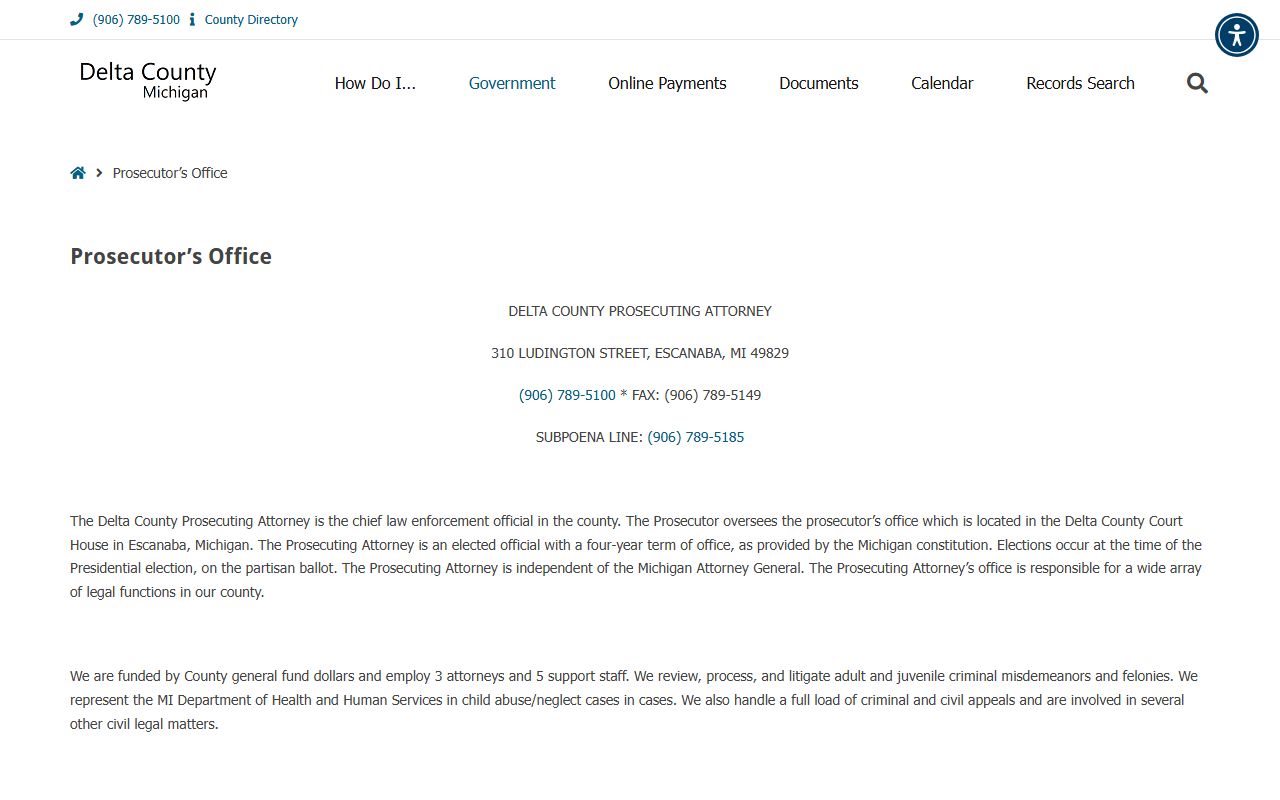
That office files both adult and juvenile criminal matters, which is where most Delta County criminal court records begin.
How to Search Delta County Criminal Court Records
Delta County does not run its own public criminal case portal. Statewide court cases are searched through MiCOURT case search, which may show criminal, traffic, civil, domestic, and probate matters depending on the court. A search there can pull a case by name or docket number and open the docket behind it.
- Open the MiCOURT case search portal on the state courts website.
- Search by defendant name or by case number.
- Narrow by court, case type, and filing date to shrink the list.
- Open a matching case to read the docket, hearings, and disposition.
- Request a certified copy from the county clerk when an official version is needed.
Older files, sealed matters, or records not yet online take a different path. The Delta County Clerk holds paper and imaged files at the courthouse and can produce certified copies for a set fee. When a record is not posted anywhere, a written request under the county Freedom of Information Act process, or a call to the clerk, is the fallback. Beyond a single case, the broader set of civil, family, and criminal files is covered under Delta County court records.
Stages of a Delta County Criminal Case
A criminal case moves through the court in set stages, and each one leaves a mark in the record. The docket lists the date of every step.
Case flow: Charges Filed › Arraignment › Pretrial / Motions › Plea or Trial › Disposition › Sentencing
| Stage | What Happens |
|---|---|
| Arraignment | The defendant hears the charges, enters a first plea, and the judge sets bond or release terms. |
| Pretrial / Motions | Lawyers trade evidence, argue motions, and try to resolve the case before trial. |
| Plea or Trial | The defendant pleads, or a judge or jury decides guilt after hearing the proof. |
| Sentencing | After a plea or guilty verdict, the judge imposes fines, probation, jail, or prison. |
Felony cases add a step. After arraignment in the 94th District Court, a preliminary examination tests whether enough proof exists to send the case up. If it clears that bar, the case is bound over to the 47th Circuit Court for trial and sentencing.
What a Delta County Criminal Court Record Shows
A criminal case file is built from a handful of core fields. Read together, they tell the full story of the charge and the result. The table below breaks down the parts that matter most in a Delta County file.
| Field | What It Shows |
|---|---|
| Case Number | The unique docket ID the court assigns, used to pull every filing in the matter. |
| Defendant | The person charged, listed by name and a case-level identifier. |
| Charges | Each count as filed, with the statute or MCL citation and the severity level. |
| Plea | How the defendant answered: guilty, not guilty, or no contest. |
| Disposition | The final outcome, such as a conviction, dismissal, or acquittal. |
| Sentence | The penalty imposed, including fines, costs, probation, jail, or prison. |
Note: Michigan court rules keep certain personal details, such as birth dates and Social Security numbers, out of the public copies of a case file.
Charges vs. Convictions
Being charged is not the same as being convicted. A charge is only an accusation that a crime occurred. A conviction is a proven result, reached by a plea or a verdict. A criminal court record can hold charges that were later dropped, dismissed, or ended in acquittal. Reading the disposition, not just the charge, shows how a case actually ended.
| Charge | Conviction | |
|---|---|---|
| Stage | Accusation | Verdict or plea |
| Burden of Proof | Probable cause | Beyond reasonable doubt |
| Public Record | Yes | Yes |
A closer look at the charges themselves, from the complaint through charge codes and severity, sits in the Delta County arrest records and court charges page.
Reading Dispositions and Sentences
A disposition is the final outcome recorded on a case. Common entries include guilty, not guilty, dismissed, and nolo contendere, which means no contest. A deferred outcome holds judgment while the defendant meets set conditions. The sentence sits next to the disposition and spells out the penalty.
A sentence can mix several parts. It may list a fine, court costs, a jail term in the county facility, or a prison term under state custody. Probation means supervision in the community, either instead of custody or after it. Parole is supervised release from prison, decided later by the state. The record notes the length of each term and any credit for time already served.
OTIS vs. the Court Criminal File
The Offender Tracking Information System, known as OTIS, is often mistaken for a county case lookup. It is not. OTIS is run by the Michigan Department of Corrections and covers people under state supervision, meaning prisoners, parolees, and probationers. It does not list everyone booked into the county jail, and it is not a county-jail roster. A person can have a full criminal court file in Delta County and never appear in OTIS at all.
OTIS and the court file answer different questions. The court file shows how a case was charged, argued, and decided. OTIS shows the supervision side after a prison sentence: the offense, the minimum and maximum term, the MCL cited, the sentencing county, and the current status. For jail custody questions, the sheriff must be called directly, since the county does not post a public jail roster online.
The state explains the tool and its limits on the MDOC OTIS page.
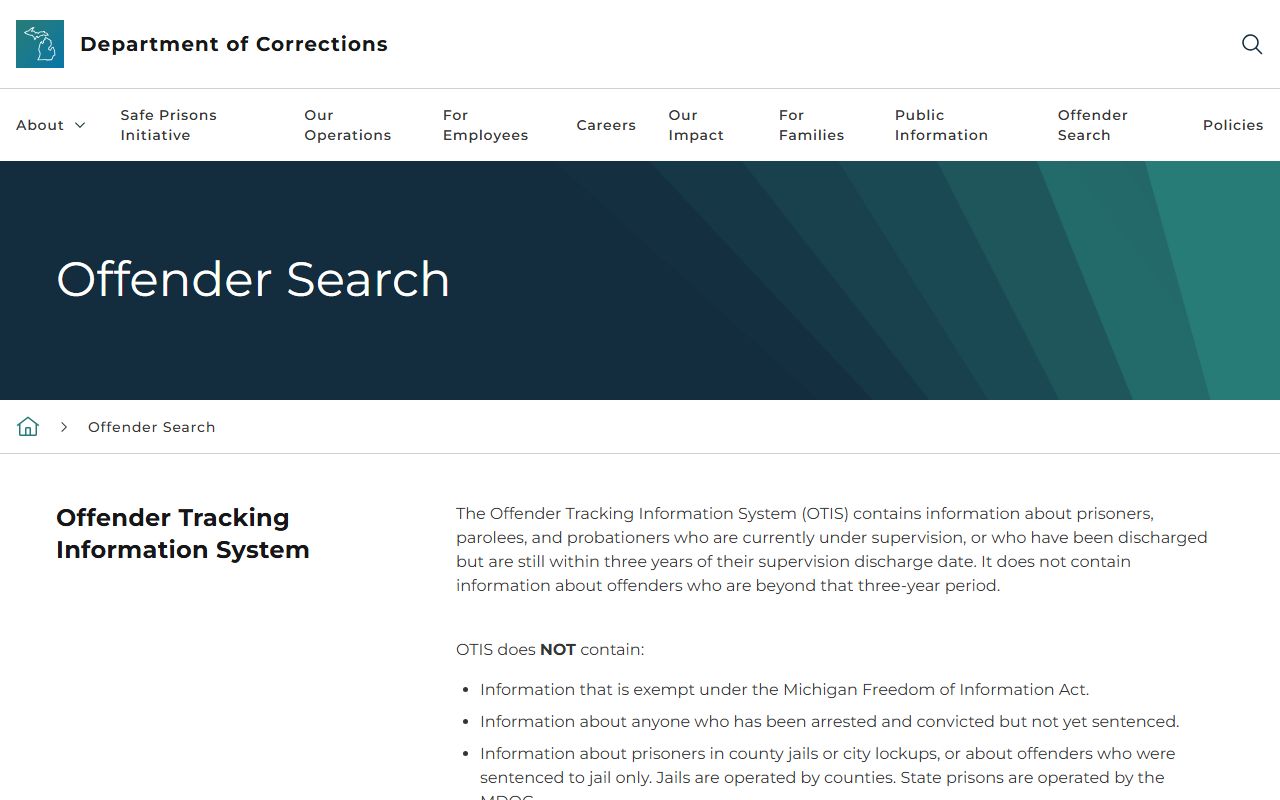
OTIS data updates on the state's own schedule, so it can lag behind a recent court disposition.
The department also notes how its systems differ from federal custody on its corrections FAQ page.
That distinction matters because a federal sentence never shows up in the state system at all.
Sealed vs. Expunged Criminal Records
Michigan lets some people set aside a conviction, which the law treats much like sealing a record. A set-aside removes the conviction from public view once a court grants it. The main statute controls who may petition and when. Certain offenses are excluded outright, and a few now clear on their own without any filing.
| Sealed | Expunged | |
|---|---|---|
| Visibility | Hidden from public | Treated as never having existed |
| Law Enforcement | Limited access | Very limited access |
| Eligibility | Petition to set aside under MCL 780.621 | Automatic for some under Clean Slate, MCL 780.621g |
The petition path runs through a single state form. Setting aside a conviction under MCL 780.621 follows a set order:
- Confirm the offense is eligible under the set-aside law.
- Complete SCAO application form MC 227.
- Pay the $50 application fee listed on the form.
- Send a copy to the Michigan State Police records center.
- Serve the prosecuting attorney and other required parties, then file with the court that entered the conviction.
State law also lists offenses that cannot be set aside, spelled out in MCL 780.621c.
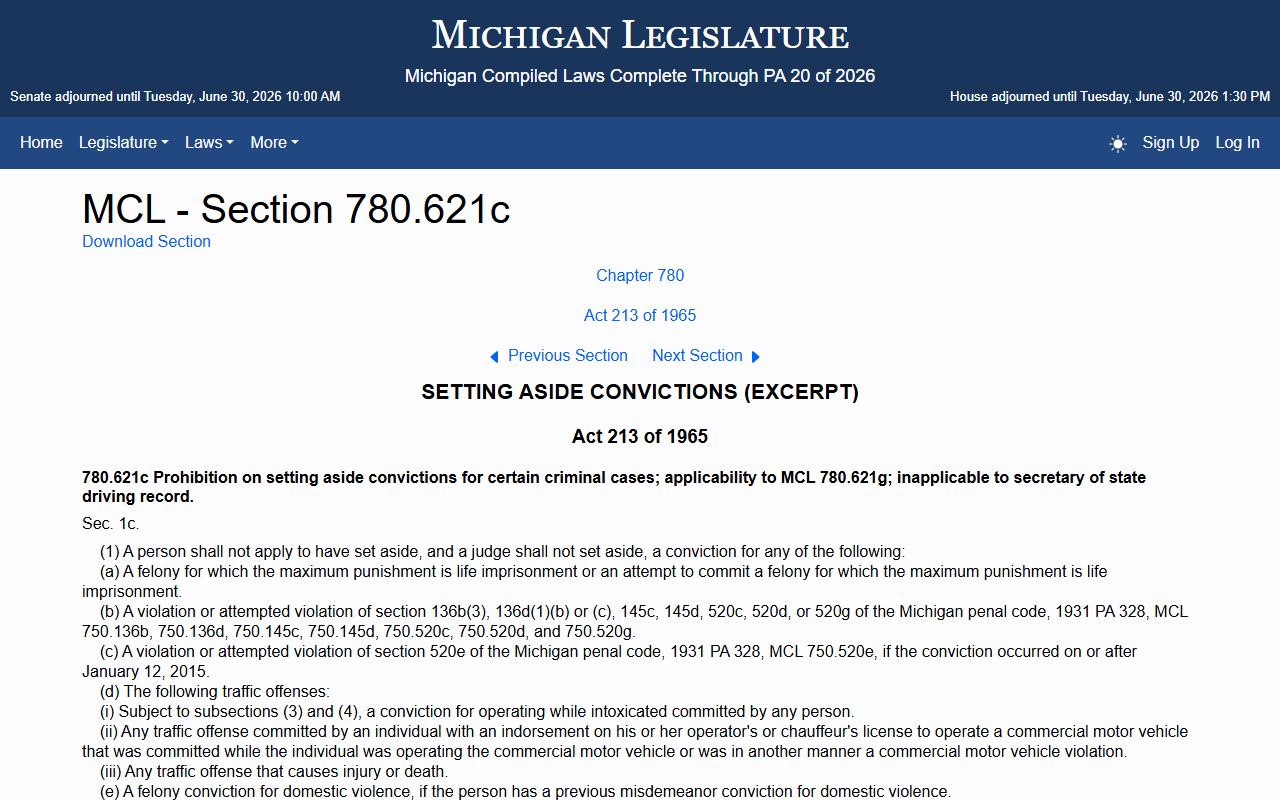
Reading that exclusion list first saves the cost of a petition that cannot succeed.
The newer Clean Slate rules that clear some records without a filing appear in MCL 780.621g.
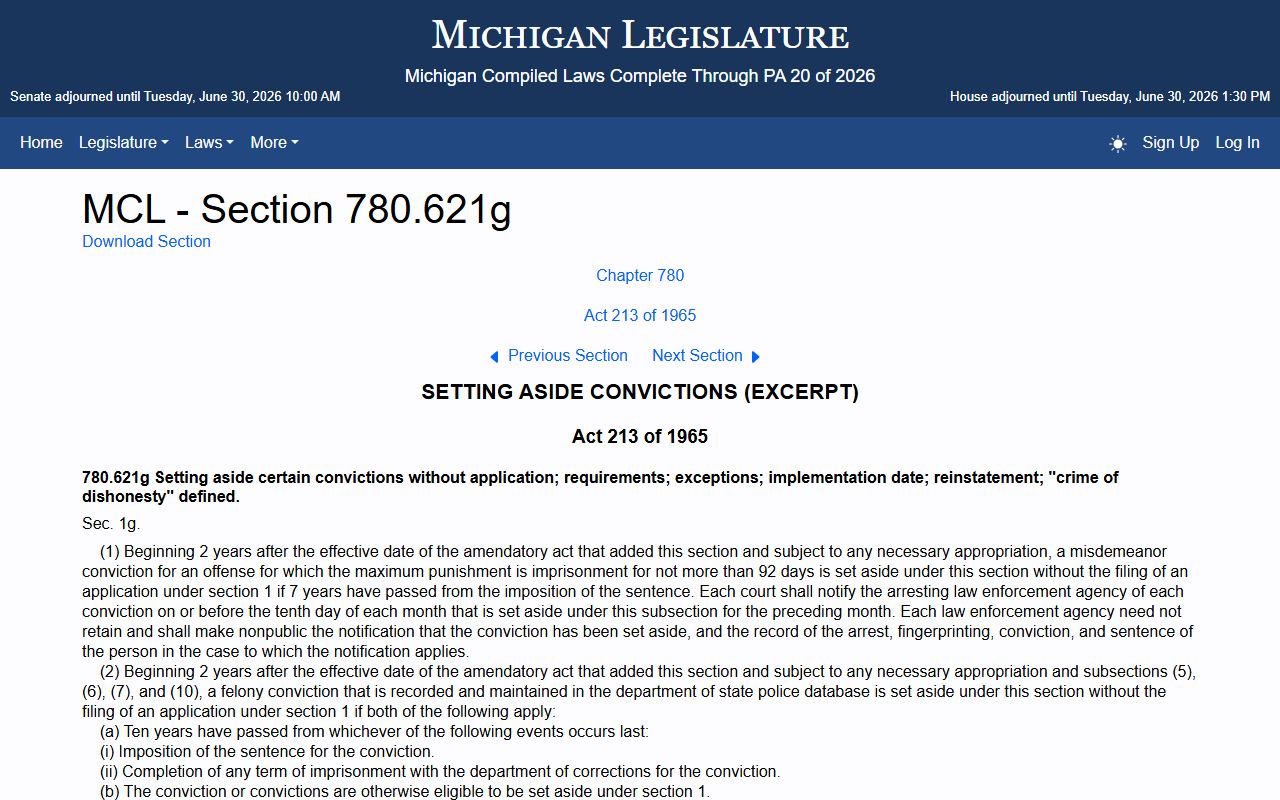
Under those rules, eligible convictions are set aside on a schedule with no application at all. A set-aside does not refund any fines or costs already paid.
Federal Criminal Cases in Delta County
Some Delta County crimes are prosecuted in federal court, not state court. The county sits in the U.S. District Court for the Western District of Michigan, Northern Division. The division office that serves the Upper Peninsula is the Marquette clerk office. Federal charges cover matters like federal drug, firearm, and fraud crimes, and they follow their own docket, wholly separate from any state file.
Federal charges are filed by the U.S. Attorney for the Western District of Michigan. Those case files are not on MiCOURT. They live in the federal PACER system, which hosts docket sheets and filings for district courts nationwide. A federal criminal record therefore takes a different search than a state one, and it will not appear in a county clerk search or in OTIS.
Federal custody is tracked apart from the state as well. A person serving a federal sentence appears in the Bureau of Prisons locator, not in any state list.
The prosecuting office for federal matters is the U.S. Attorney's Office for the Western District of Michigan.
Its main office sits in Grand Rapids, while Marquette anchors the Northern Division for Upper Peninsula cases.
Federal inmates are found through the Bureau of Prisons inmate locator.
That tool covers people in federal custody, which the county jail roster and OTIS do not.
Public Access to Delta County Criminal Records
Michigan treats court records as open unless a statute, a rule, or an order says otherwise. The rule that governs case-file access is the state court rule on court records. State FOIA sets the broader public-records policy for government files. Together they keep most criminal case files open while shielding sensitive personal data from public copies.
Key Statutes:
Michigan Court Rule 8.119 - Criminal case files stay public unless sealed by statute, rule, or court order.
Michigan FOIA, MCL 15.231 - State policy favors full public access to government records, subject to set limits.
Criminal Background Check Considerations
A casual name search is not the same as a background check. Employers, landlords, and lenders that use records for those decisions must follow the federal Fair Credit Reporting Act. A court file read out of personal curiosity carries no such duty. For a formal criminal-history check, the state offers ICHAT through the Michigan State Police, which is the proper public criminal-history tool and is not a warrant list.
Important: This site is not a consumer reporting agency under the Fair Credit Reporting Act, and its content may not be used for hiring, housing, or credit decisions.
Restricted Criminal Court Records in Delta County
Not every criminal matter is open to the public. Juvenile cases are restricted under MCL 712A.28 and are opened only by court order. Sealed and set-aside convictions drop out of public view. Parts of an active investigation can stay closed until the case resolves. Protected personal data, such as a birth date or a Social Security number, is redacted from the public copies across all case types.
Note: Juvenile criminal records in Delta County are opened only when a judge orders it, so they will not appear in a routine public case search.