
Getting a Marriage License in Delta County
A marriage license here comes from the county clerk, not from a judge. Nancy Przewrocki serves as the Delta County Clerk, and her office works inside the courthouse at 310 Ludington Street in Escanaba. Where a couple applies depends on residency. Michigan residents apply in the county where they live. Couples from another state apply in the county where the wedding will happen. Both applicants should appear together when they can. The clerk's marriage license page spells out the rules, and the office keeps public hours of 8:00 a.m. to 4:00 p.m., so plan the trip during the workday.
Most applicants only need valid photo identification and a few personal details. An applicant who is 16 must appear with a parent or legal guardian. That younger applicant also brings a certified birth certificate plus the parent or guardian's photo ID. At least one signature on the application must be notarized or signed inside the clerk's office. Michigan applies a three-day waiting period after the application is filed. Once issued, the license stays valid for 30 days. If the wedding slides past that window, the couple has to start again.
A visit to the clerk turns those rules into a short, in-person errand.
The county explains the full process on its own marriage license information page, shown below.
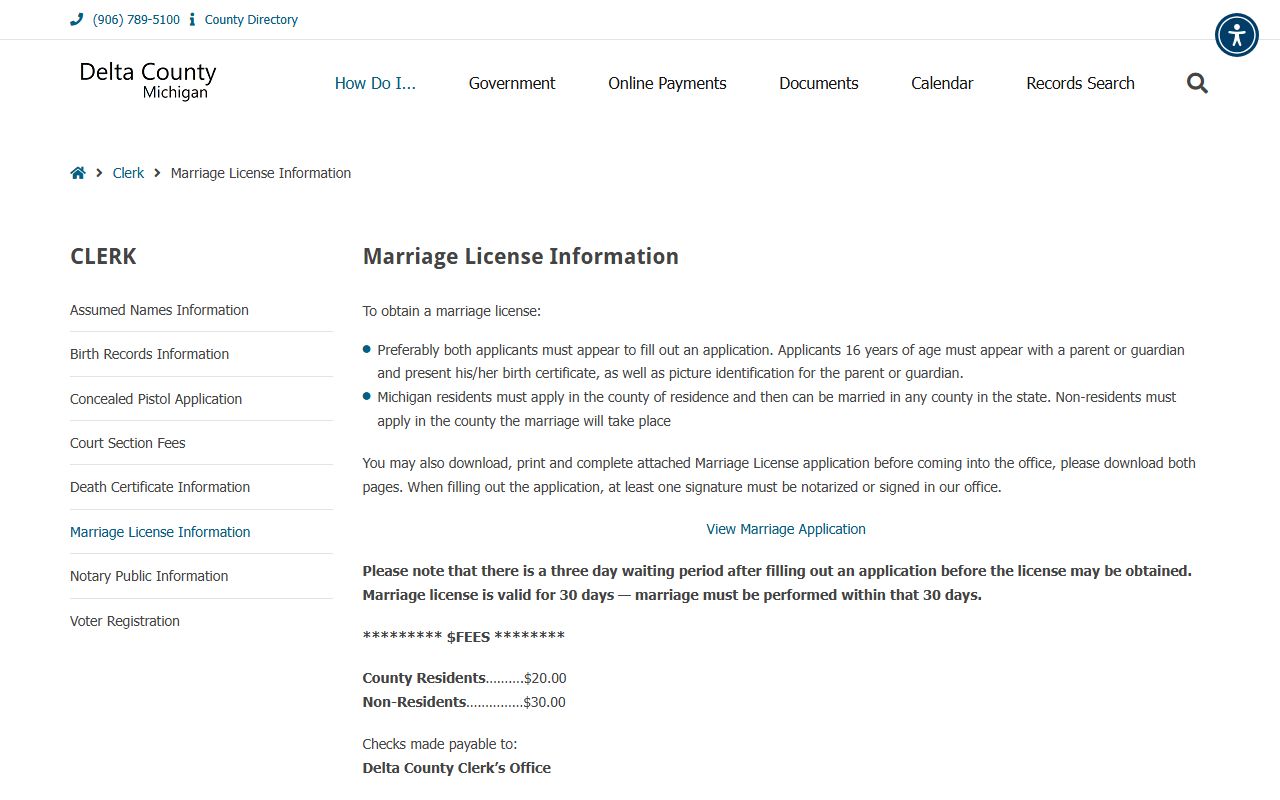
The county page confirms residency rules, the waiting period, and the approved way to order copies later, so it is the best starting point before a couple heads downtown.
How to Apply for a Marriage License
A little preparation keeps the visit quick. Gather identification for both applicants first, sort out which county has authority based on residency, and set aside time for the three-day wait before the license issues. The steps below follow the county's stated process.
- Confirm the correct county. Michigan residents apply where they live, while out-of-state couples apply where the ceremony will take place.
- Both applicants should go to the clerk's office together whenever possible and bring valid photo identification.
- An applicant who is 16 appears with a parent or guardian and brings a certified birth certificate along with the parent or guardian's photo ID.
- Complete the application and provide the required personal details. At least one signature must be notarized or signed in the office.
- Pay the license fee. Residents and non-residents pay different amounts.
- Wait out the three-day period, collect the license, and marry within 30 days before it expires.
Delta County Marriage and Divorce Fees
Costs split between the clerk side and the court side. The marriage license fee is set by residency. Divorce filing fees live on the county's court-section fee schedule and change when minor children are involved. Certified copies of any vital record carry a per-page charge. The figures below come from the county's published fee pages.
| Item | Amount |
|---|---|
| Marriage license, Michigan resident | $20 |
| Marriage license, non-resident | $30 |
| Divorce filing, no minor children | $175 |
| Divorce filing, with minor children | $255 |
| Certified copy, first page | $10 |
| Certified copy, each additional page | $1 |
Checks and money orders are made payable to the Delta County Clerk's Office. The court-section fee page lists the divorce amounts alongside other filing and copy charges. Note: the divorce filing fees are court costs paid to start a case and do not include attorney fees, service costs, or later motion fees.
Searching Delta County Marriage Records
The county keeps a searchable marriage index that goes back generations. Volunteers copied the records, and the marriage records index covers unions from 1862 through 2014. The database is public and needs no login. Each entry ties to a bride and a groom, and the county notes that the books hold separate A and B records for each. The physical books can still be consulted in person at the clerk's office.
The county's marriage index page, pictured here, shows the year span and how the collection is organized.
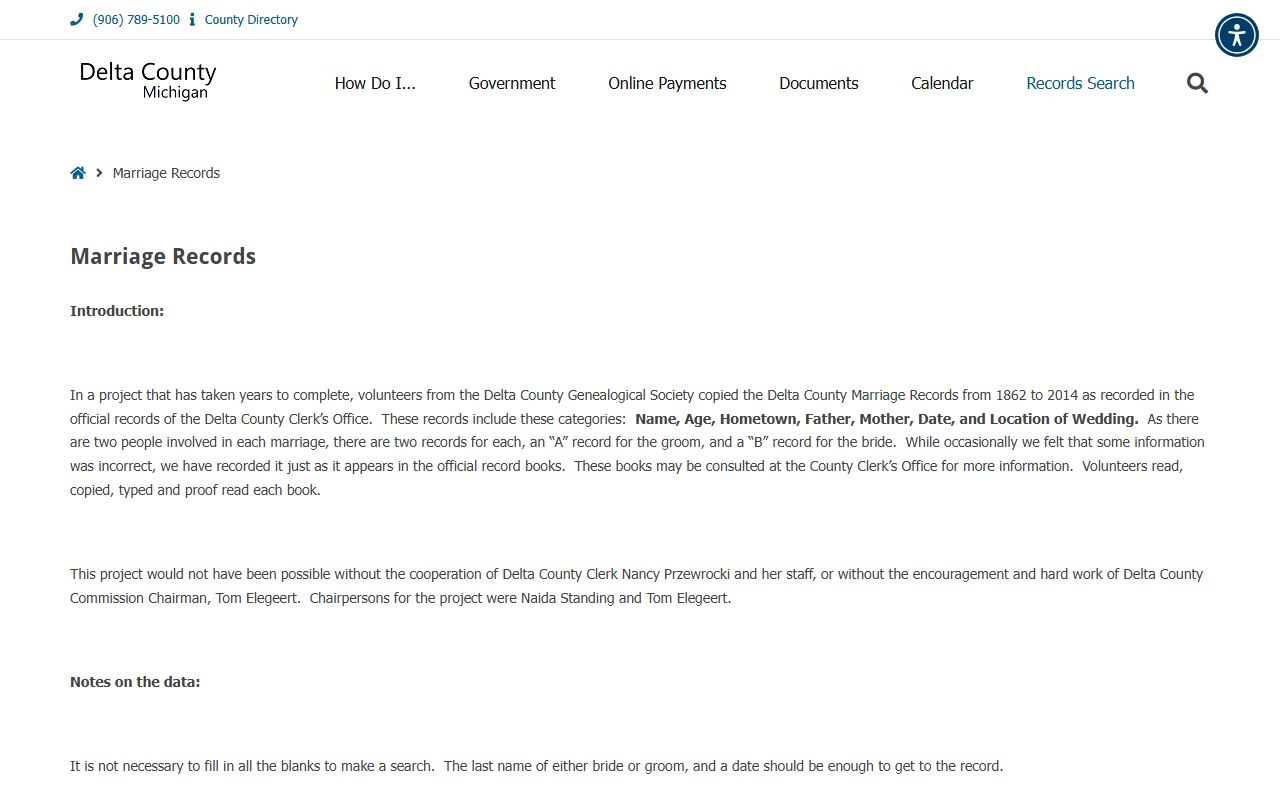
That index feeds a simple search form. The form lets you pick whether your name is the bride or the groom, then filter by name, age, parents, date, and more. Using several fields at once narrows a large result set fast.
| Field | Type | Notes |
|---|---|---|
| Bride/Groom | Dropdown | Choose Select, Bride, or Groom |
| Name | Text | Any part of the name usually works |
| Age | Text | Age at the time of marriage |
| Place of Birth | Text | Helps separate common names |
| Father | Text | Parent name for older records |
| Mother | Text | Parent name for older records |
| Date | Text | Marriage date |
| Location | Text | Where the marriage occurred |
| Book | Text | Index book reference |
The live marriage records search tool puts those fields in front of you.
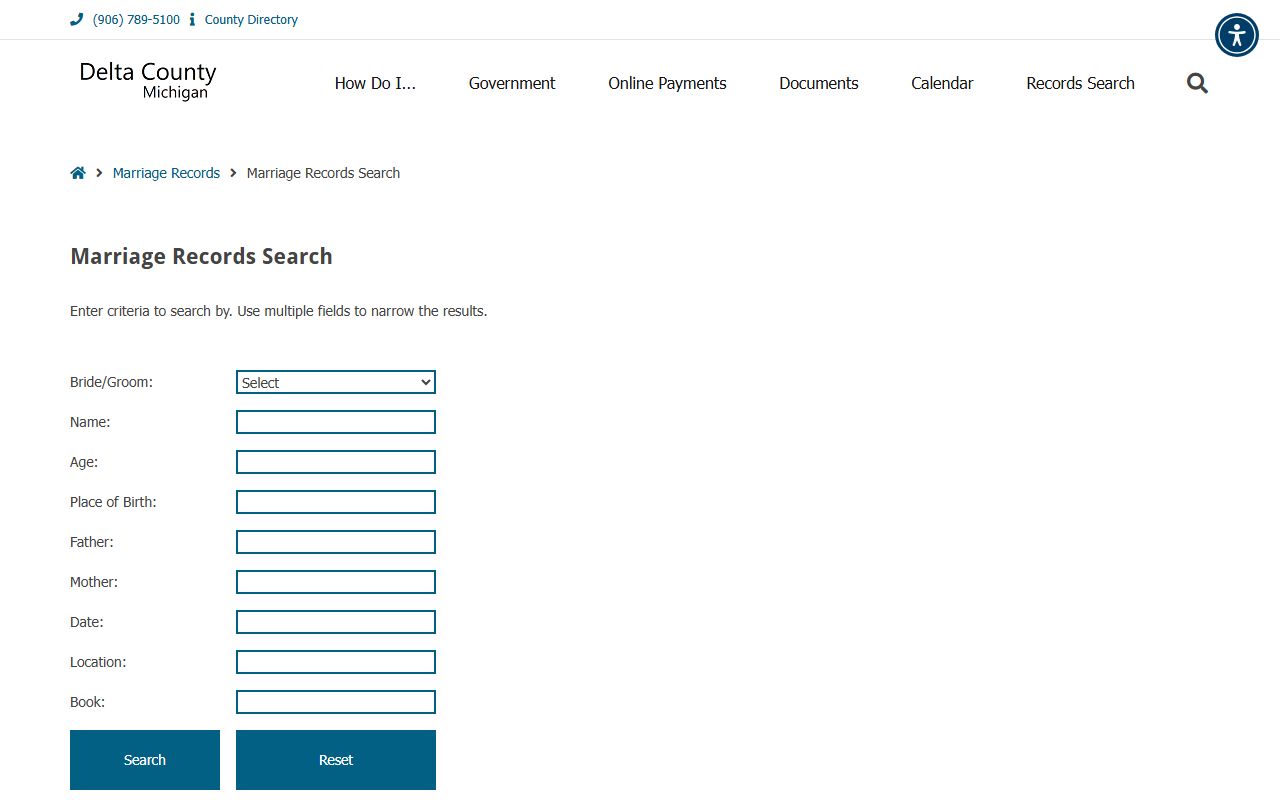
Start broad with a last name, then add a parent name, a date, or a book reference to zero in on the right entry.
Ordering Certified Copies and Related Indexes
The searchable index tells you a record exists, but it is not a certified document. For a legal copy, the county uses one approved online vendor. Certified vital-record copies are ordered through VitalDirector by Permitium, which the county lists as its only approved online vital-record provider. The same vendor handles marriage, birth, and death certificate orders. A certified copy costs $10 for the first page and $1 for each additional page.
The clerk's vital-records work reaches beyond marriage. The county also publishes a historical birth index and a death index, both built the same way as the marriage collection.
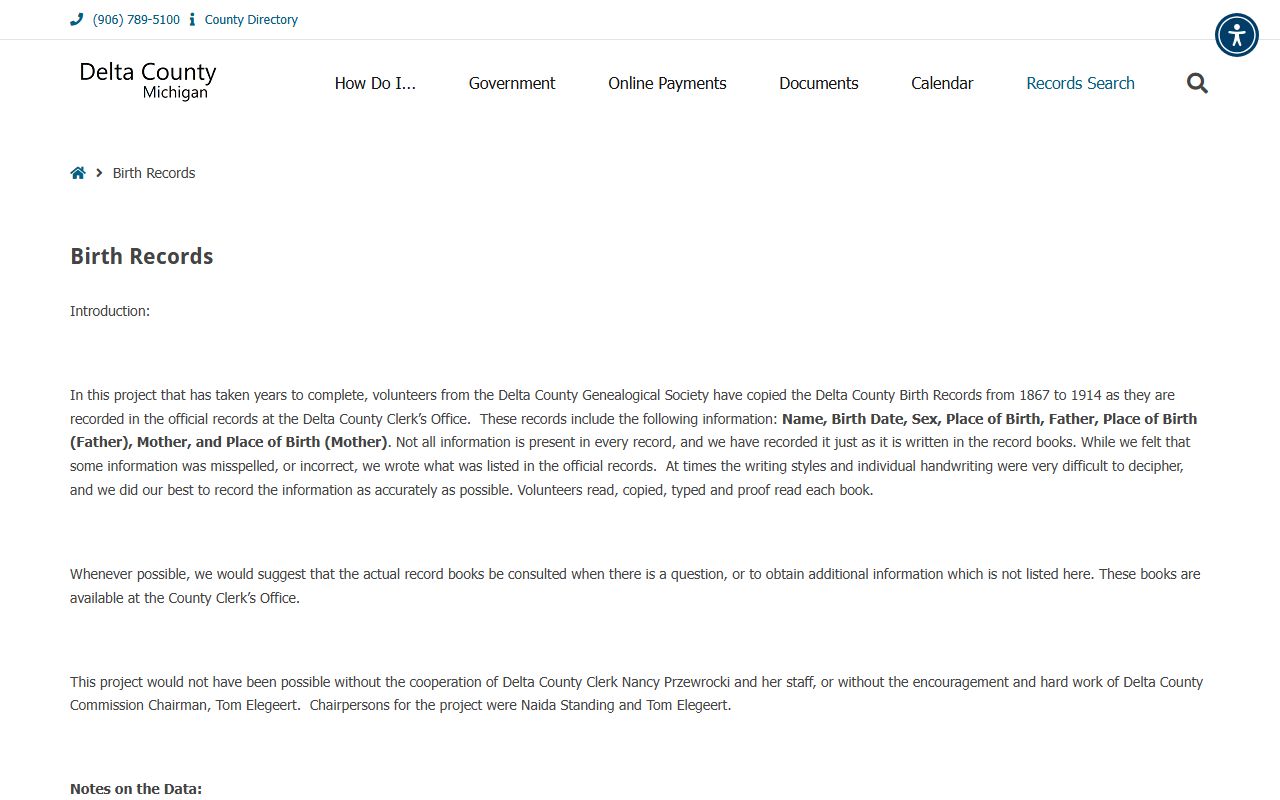
Birth certificates are not open to the public. Only the person named or the parents can obtain a certified birth copy, and the office asks for a driver's license or three pieces of identification including one photo ID.
The birth records search form, shown here, mirrors the marriage tool with fields for name, birth date, place of birth, and parents.
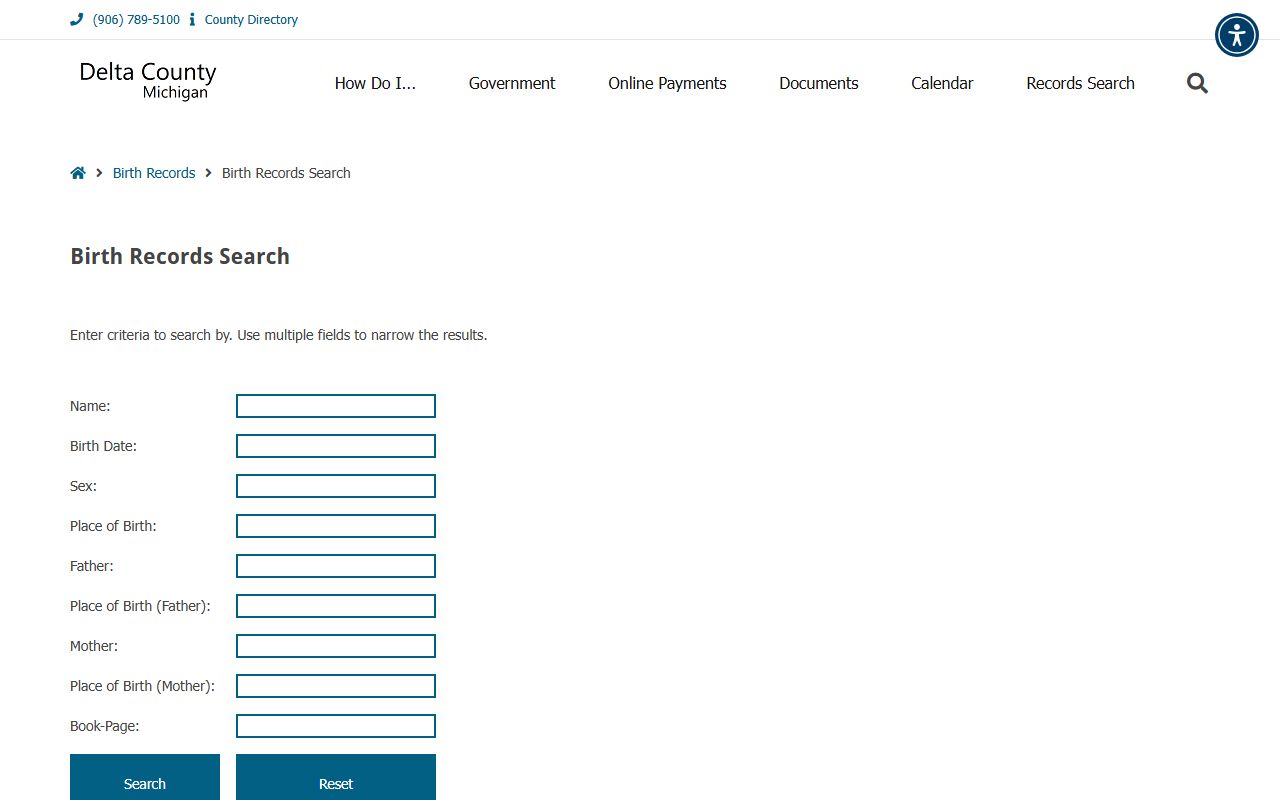
Genealogists lean on these indexes because the coverage runs deep, but a certified copy always routes back through VitalDirector or the clerk's counter.
Finding Delta County Divorce Records
Divorce is a court matter, not a clerk vital record. In Michigan these cases run through the circuit court family division. In Delta County that court is the 47th Circuit Court, which sits in the same downtown courthouse. Custody, parenting time, paternity, and support are managed with help from the Friend of the Court, the office that supports the family division. A divorce without minor children costs $175 to file. A divorce that involves minor children costs $255.
A completed divorce file can hold the complaint, the judgment, and related orders on property, support, and parenting time. Some material stays limited. Protected personal details are redacted, and matters involving children can carry tighter access rules.
The county does not publish a full step-by-step divorce filing walkthrough, and it does not post local residency or no-fault details online.
Because of that gap, the circuit court and the Friend of the Court are the offices to contact for filing help, and statewide court search tools cover many case dockets. Note: divorce case questions go to the circuit court and Friend of the Court, while certified marriage certificates come from the clerk or VitalDirector.
Public and Restricted Delta County Vital Records
Access rules differ by record type. Michigan court records, including divorce case files, are public unless a statute, court rule, or sealing order restricts them, a standard set by Michigan Court Rule 8.119. Marriage index entries are open and searchable. Birth certificates are closed to the general public and go only to the person named or the parents.
The county's death index, pictured below, is public for genealogy, yet a certified death copy still follows the clerk's identification and fee rules.
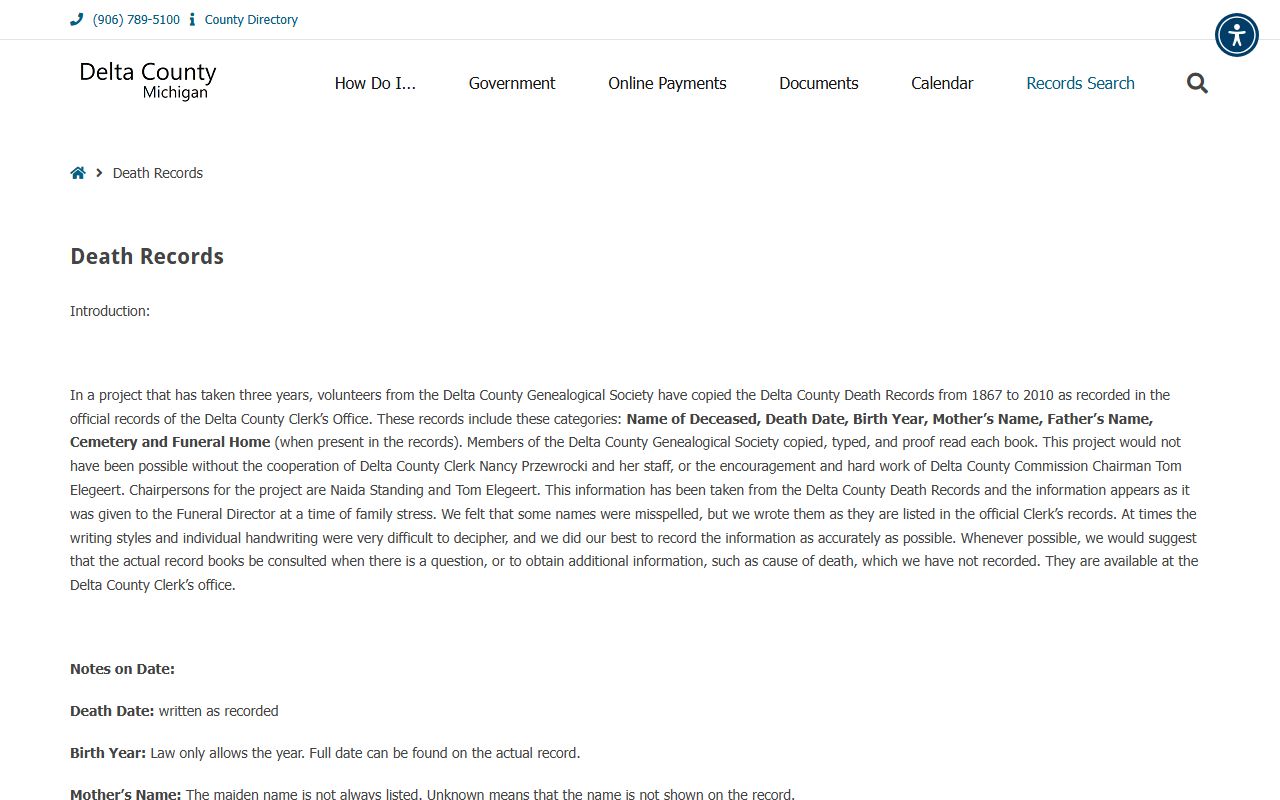
Certain details are always shielded. Michigan protects personal identifiers such as dates of birth, Social Security numbers, and account numbers, and courts redact them from public filings. Juvenile and adoption records generally stay closed unless the law or a judge allows access. When a record is too old, sealed, or missing from a portal, a Freedom of Information Act request to the county or a visit to the clerk's counter is the fallback. Related estate and guardianship files sit with the Delta County probate records office rather than the clerk.
Delta County Vital Records Office
The county clerk is the local vital-records office for marriage, birth, and death certificates, and it is the front door for most requests. The office shares the courthouse address with the circuit and district courts. For records the clerk does not hold, such as estate files or a divorce docket, the county clerk of court page and the courts route requests to the right desk. Contact details are below.
Delta County Clerk Vital Records
310 Ludington Street
Escanaba, MI 49829
(906) 789-5100